AC Transit's Budget Outlook
Frequently Asked Questions and Resources
May 27, 2026
We know riders and community members want clear information about AC Transit’s financial outlook. With frequent reports across news outlets and social media, it can be difficult to distinguish verified facts from opinion, rumor, and speculation.
These Frequently Asked Questions (FAQ) present straightforward answers to the questions we hear most often about AC Transit’s budget outlook, the factors contributing to today’s financial challenges, and the efforts underway to navigate the years ahead. Learn about the proposed Contingency Service Plan here.
Why is AC Transit facing a financial crisis right now?
AC Transit is at a historic financial crossroads. The emergency relief funding that sustained our service through the pandemic is now gone. At the same time, costs of operating transit are rising – from wages and benefits to fuel, parts, and bus production – while the rise in costs has outpaced revenues. It is important to note, although ridership patterns have shifted, neither AC Transit nor any transit agency is sustained through fares alone. That is why, without additional funding, our 65-year-old transit district is facing unavoidable service cuts of up to 16% and potential layoffs impacting as many as 300 employees.
How significant is AC Transit’s budget shortfall today?
AC Transit’s costs are expected to grow faster than our revenue year after year. When expenses rise and funding does not keep pace, the gap between the cost of serving our riders and the money available to support that service continues to widen over time. Without new, reliable funding, AC Transit will continue to face large budget shortfalls over at least the next five years.
- July 1, 2026 – June 30, 2027 (FY 27): $60 million
- July 1, 2027 – June 30, 2028 (FY 28): $43 million
- July 1, 2028 – June 30, 2029 (FY 29): $53 million
- July 1, 2029 – June 30, 2030 (FY 30): $48 million
- July 1, 2030 – June 30, 2031 (FY 31): $53 million
Wasn’t there recent state-based help for Bay Area transit agencies?
Yes. We are grateful to the State of California and Governor Gavin Newsom, the Metropolitan Transportation Commission (MTC), and the people of California for advancing a $590 million bridge loan to Bay Area transit agencies, including AC Transit, BART, Caltrain, and SFMTA/MUNI. Under this funding framework, AC Transit may draw up to $55 million for operations. This will help close our $60 million budget gap for FY 2027 and avoid immediate cuts. But it is not a long-term solution. Importantly, this funding is not a grant, it must be repaid. The agreement includes an initial two-year interest-only period, meaning each agency will not begin paying down the principal right away. After that, there is a ten-year repayment term.
What has AC Transit done to control costs?
Relying on service cuts alone to close a growing deficit is a short-sighted and unbalanced approach. That is why every AC Transit department has been tightening spending and finding real efficiencies. AC Transit received approval to temporarily reduce pension payments in FY 2026–27 and repay the difference later with interest, easing short-term budget pressure. Hiring is now limited to critical roles that directly support service. We are reducing reliance on outside professional services. The use of temporary employees has been scaled back, saving up to $2 million each year. We are also leveraging cooperative contracts with the state and other public agencies to secure goods and services at lower cost, stretching every dollar further.
For the current fiscal year, we have already cut spending by more than $9 million.
Are service and job cuts already underway?
At this stage, no jobs or bus lines have been cut, and no detailed service changes have been presented to the Board of Directors. But the reality is straightforward. Costs are rising faster than revenue, and that deficit gap is forcing tough decisions now, not later. That is why, in March 2026, AC Transit’s Board of Directors approved the framework for an Alternate Service Plan – the first step in considering possible service cuts.
Learn more about the Alternate Service Plan Framework here
What’s the plan for service if AC Transit does not secure funding?
AC Transit knows that any service cuts will hurt the people of the East Bay, and the economy of the Bay Area region. Service cuts are part of a contingency plan we must be prepared to carry out if a sustainable funding source does not materialize.
Think of the Draft Contingency Service Plan as the emergency backup plan for a worst-case scenario. Right now, the focus is on defining what the impacts could be. The plan is based on a projected annual deficit of up to $53 million, resulting in a four-year, $200 million shortfall beginning in 2028. To help close the gap, the agency would need to reduce service by 16% and could lay off up to 300 workers .
These are not small adjustments, but changes that would reshape service across our service area.
When could service reductions take effect?
The AC Transit Board of Directors will consider service reduction options at its meeting on June 10, 2026, at 5 pm. Any changes would take effect in June 2027, following a required public hearing process.
How does the Realign network fit into talks of service cuts?
AC Transit is focused on protecting, not dismantling. We are working to preserve the Realign network, launched in summer 2025. It is our current operating network, where 123 of 130 bus lines were updated or redesigned to reflect how people travel today.
Realign-designed service carries 3.3 million people every month and was shaped by years of input from riders, communities, and frontline employees. We are not starting over. We are working to protect what works, even as financial pressure continues to grow.
Was there a single event that led to the fiscal crisis?
No. It is the result of multiple economic and other pressures hitting at once. Bay Area workers traveling to work by bus less often has lowered ridership. However, unlike rail systems, fares collected have never been a major part of AC Transit’s budget. We are working every day to ensure that every rider pays their “fair share,” but we need more to keep rolling. The state, local and federal funding that have historically supported transit has also failed to keep up with the needs, which is why a new, stable revenue source is needed.
At the same time, the emergency relief funds that helped stabilize AC Transit, and transit agencies nationwide, through the pandemic were always temporary. Now they are gone. Their expiration has not exposed the full weight of these underlying financial pressures but magnified how inflation is impacting every part of our transit operations.
Why didn’t AC Transit prepare for this crisis?
We did prepare. In fact, we built reserves (i.e. savings), but they’re temporary and will not last beyond this year. Here’s what’s driving our crisis. The federal government began warning as early as 2021 that all transit agencies could face a “fiscal cliff.” AC Transit took that warning seriously from the start, slashing non-service spending by more than $9 million and saving cash. We then tracked how changing ridership patterns were reshaping transit revenue here and nationwide. We also monitored the state and local governments, and their declining revenues. Yet at the same time, our mandatory costs, like new buses, parts, and fuel skyrocketed, beyond normal inflation. Bottom line: shifting commute habits, higher costs, and less funding now mean AC Transit is in long-term crisis. We’re doing everything possible to operate at the lowest cost through internal cuts. At this point, there are no additional spending cuts without impacting service. As a critical East Bay public service, AC Transit needs a new, sustainable revenue source now, to keep riders moving.
What happens when costs rise but revenue doesn’t?
You get the situation where we find ourselves now. Fuel is more expensive than ever. Buses cost more to make for a number of reasons. While the parts needed to service our buses can be more expensive, AC Transit is already working hard to save money long-term by steadily modernizing our fleet. Newer buses are more reliable and require less frequent maintenance, which means we actually need fewer parts each year than the year before.
It’s important to remember, many of our cost increases are unavoidable.
What are riders not seeing in the cost of service?
Beyond labor, the cost of running transit is climbing fast. Maintenance isn’t just expensive, it’s surging. Utilities are up. Insurance and claims are rising. Fuel costs have jumped 20%, and bus parts are up 14%. These are not optional expenses. They are the cost of keeping buses safe and in service.
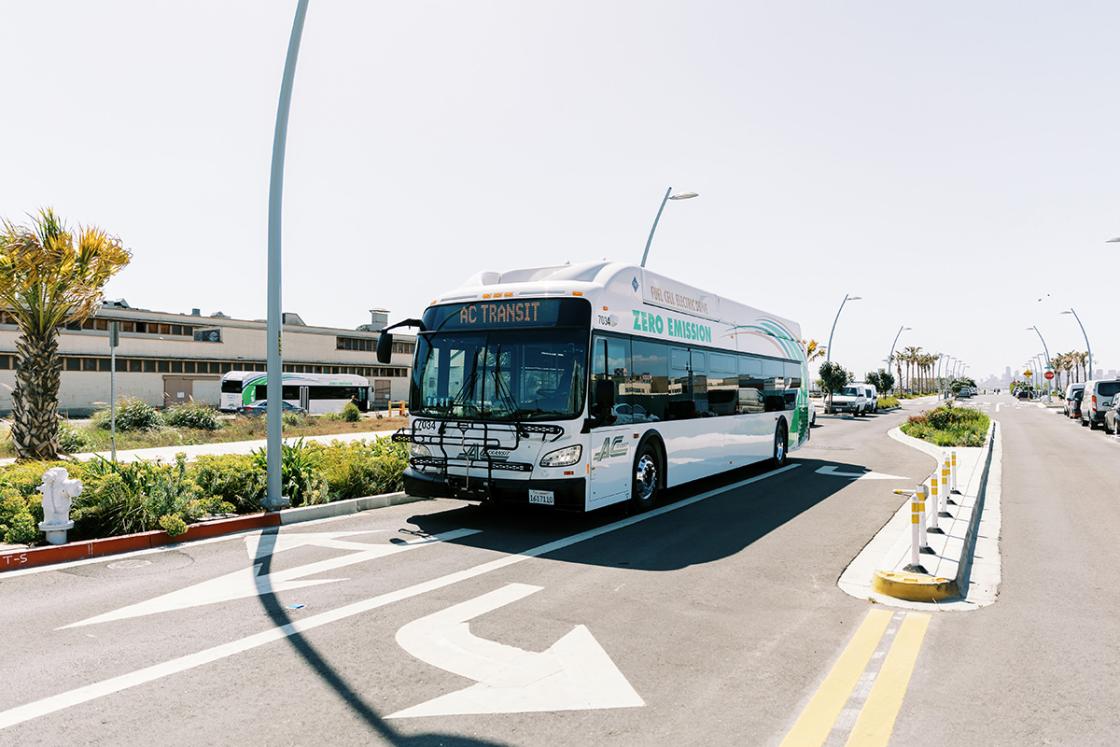
At the same time, we are facing an aging fleet. A transit bus has a lifespan of about 12 years, and the cost to manufacture one has increased by 35% in just the past two years. Replacing buses is not a choice. It is essential. A significant portion of our fleet is now nearing the end of that lifecycle. This is not just about whether we can afford to run service today. It is about whether we can sustain reliable service tomorrow. We also face mandates by the state of California that we increase zero emission bus (ZEB) service. Unfortunately, California has not provided the funding needed for transit agencies to meet its zero-emission fleet mandate. AC Transit, however, has led the nation in converting our fleet to battery-electric and hydrogen powered buses, which dramatically decreases greenhouse gas pollution. However, even necessary investments introduce cost pressures: ZEBs are more expensive to buy, fuel, and operate.
What’s being done to secure sustainable and long-term funding?
California has already taken a major step. In 2025, the State passed Senate Bill 63, also known as the Connect Bay Area Act, and it was signed into law by Governor Newsom.
- The law authorizes a potential regional transit funding measure that could appear on the November 2026 ballot across five Bay Area counties.
- If placed on the ballot and approved by voters, the measure would be funded through a 14-year sales tax – a half-cent in most counties and one cent in San Francisco – and is estimated to generate about $980 million annually to support public transportation.
- Most of that funding would go toward keeping transit service running, including buses, trains, and ferries, along with investments in local improvements and the rider experience.
- If the measure is approved by voters, AC Transit is estimated to receive approximately $51 million annually to help sustain service.
Citizens have signed petitions to place this transit funding measure on the ballot. These signatures were accepted and certified by the Public Transit Revenue Measure District on July 24, 2026.
View the Metropolitan Transportation Commission (MTC) SB63 Fact Sheet.
What is AC Transit doing to maximize efficiencies and increase revenues?
We continue to be careful stewards of public funds, as reflected in our transit district’s consistent AA+ credit ratings.
We are also pursuing responsible revenue opportunities, including the farebox. Following the first fare increase in six years last summer, a second increase is scheduled for July 1, 2026, alongside a campaign emphasizing the importance of paying the fare and reducing fare evasion through fair enforcement.
Programs like EasyPass continue to grow ridership, improve transit access, and reduce carbon emissions. At the same time, strengthening Safety and Security helps protect riders and frontline employees while reducing long-term financial risks.
AC Transit remains focused on efficiency, innovation, and sustainable revenue solutions that strengthen long-term financial stability for the East Bay.
Resources
- AC Transit Board of Directors: Proposed Contingency Service Plan (August 12, 2026)
- AC Transit Board of Directors: Proposed Contingency Service Plan (June 10, 2026): The proposed Contingency Service plan that, with Board approval of a future final draft, could be implemented in June 2027 if the regional revenue measure does not pass in November.
- AC Transit Board of Directors: Financial Projections Update (April 8, 2026): Summary of updated financial projections presented to the AC Transit Board of Directors, including projected operating deficits through FY 2031.
- AC Transit Board of Directors: Alternate Service Plan Framework (March 25, 2026): Summary of alternate service plan framework to develop service reduction recommendations to possibly be implemented in June 2027 if a significant budget deficit is likely.
- Senate Bill 63 The Connect Bay Area Act: California Legislative Information (Official bill text)
- Metropolitan Transportation Commission SB 63 Factsheet: Overview of what SB 63 authorizes, the regional governance framework, and accountability requirements.
- MGO Report: Independent Fiscal Review Summary: Independent analysis of AC Transit’s financial condition and long-term sustainability challenges.
- MTC Financial Efficiency Review Report Adopted: Press release.